In-Home ABA Therapy vs. Center-Based ABA in Virginia: Which Is Right for Your Child?
If you’re comparing in-home ABA therapy and center-based ABA, you’re probably not looking for a textbook definition of therapy. You’re trying to make a real decision for your child and your family.
You may be wondering which setting will support the goals that matter most right now, fit your routine, and feel sustainable week after week. In Virginia, that decision can also be shaped by commute time, provider availability, school coordination, and insurance logistics.
The good news is that this does not have to be an all-or-nothing choice based on guesswork. Both settings can be effective when they match a child’s needs. What matters most is fit: where your child needs support, how they respond to structure and transitions, and where progress is most likely to carry over into daily life.
What Parents Are Really Choosing Between
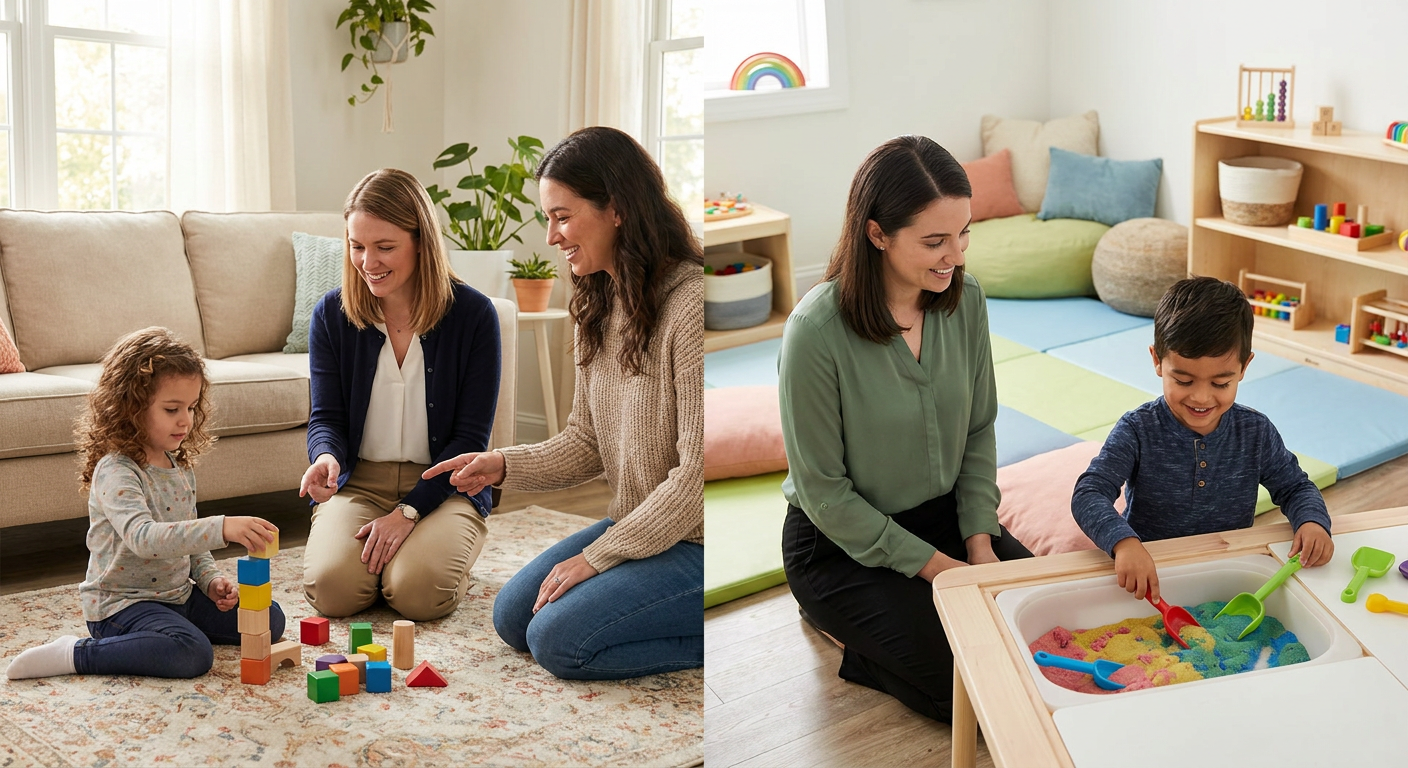
In-home ABA happens in the environment where many everyday challenges already show up. That may include mealtimes, transitions, toileting, sibling routines, play, or safety-related moments around the house.
Center-based ABA happens in a more structured setting designed for teaching and practice outside the home. For some children, that kind of routine and consistency is a real strength. It can also offer more built-in peer exposure, depending on the program.
So the real question is not, “Which model sounds better on paper?” It is, “Which setting makes the most sense for my child’s next goals?”
For a younger child, that might mean communication, play, and daily routines. For a school-age child, it might mean carryover between home and school, stronger transitions, or more support around social practice. The best choice is the one that helps those next steps feel more within reach.
A Simple Way to Decide What Fits Right Now
One helpful way to think about this decision is the SETTING Fit Method. It keeps the focus on the things that usually matter most: where the hardest moments happen, what kind of environment helps your child learn, and what your family can realistically maintain.
S — Skill location
Start with the most practical question: where do the biggest challenges happen now?
If the goals involve toileting, mealtime, sibling interactions, transitions at home, or safety concerns during daily routines, in-home ABA often makes more sense because therapy happens where those skills actually need to show up. Instead of practicing in a separate setting and hoping it transfers later, the child can learn in the same environment where the routine already exists.
For school-age children, the picture may be a little more mixed. A child might need support with after-school routines, homework, or transitions at home while also needing coordination with teachers during the school day. In those cases, families may want to look closely at providers that combine home-based care with school collaboration. You can get a feel for that model through Galaxy ABA’s in-home services and school support.
E — Environmental needs
Some children do best in a familiar environment with fewer transitions. Others benefit from the consistency of a more structured setting.
That does not mean home is automatically easier or center-based care is automatically better. It just means the environment itself matters.
If travel, unfamiliar places, or frequent transitions tend to be stressful, starting in-home may remove some friction and make learning feel steadier. If a child responds well to clear structure, predictable routines, and a more controlled teaching space, center-based ABA may be worth stronger consideration.
Sensory needs matter here too. Some children focus better with less stimulation. Others do well with a setting that has more organized activity and fewer household interruptions. The right environment is the one that supports participation, not the one that sounds more impressive.
T — Team involvement
ABA tends to work best when the adults around the child can support consistency.
In-home ABA often makes caregiver coaching feel more natural because parents can see strategies used during real routines and practice them with support. That can be especially helpful for younger children, since progress often depends on what happens between sessions as much as what happens during them.
For school-age children, the team may also include the classroom. When a provider can coordinate with teachers, it is often easier to reinforce the same skills across settings instead of treating home, school, and therapy as separate worlds.
T — Transfer potential
A skill matters most when it shows up outside the therapy session.
This is one of the biggest strengths of in-home ABA for many families. If the goal is smoother mornings, better mealtime routines, safer behavior at home, or more successful transitions, practicing in the home can make that learning feel more usable right away.
Center-based ABA may offer stronger built-in opportunities for peer interaction and repeated structured practice. That can be very valuable for some children. At the same time, peer exposure is only one part of the decision. A child whose biggest barriers happen at home may still make better day-to-day progress with in-home support, even if social opportunities are added in other ways.
ING — Immediate next goals
It helps to stay grounded in the next 60 to 90 days.
If the most urgent goals involve daily routines, communication during family activities, toileting, safety skills, or behavior that mostly happens at home, in-home ABA often has the advantage. If the biggest need is sustained structure, repeated practice outside the home, or more built-in peer learning, center-based ABA may be the better fit.
And sometimes the answer is not strictly one or the other. A hybrid approach can make sense when goals are split across settings. What matters is choosing the setting that best serves the child’s current needs, then reassessing if progress is not translating into real life.
Side-by-Side Comparison: In-Home ABA vs. Center-Based ABA
The factors below are often what parents are really weighing, even when the conversation starts more broadly.
| Factor | In-Home ABA | Center-Based ABA |
| Daily-routine goals | Strong fit for toileting, mealtime, sibling routines, safety skills, and transitions at home | Less direct for home routines unless the team has a clear carryover plan |
| Structure | Can be tailored to real family life, though the home environment is usually less controlled | Often a strong fit for children who benefit from highly structured teaching conditions |
| Distractions and sensory load | Familiar surroundings may reduce transition stress, though household distractions still matter | More controlled setting, though some children may find it overstimulating |
| Peer opportunities | Fewer built-in peer interactions during sessions | May offer more natural peer exposure and group-learning opportunities |
| Caregiver involvement | Easier to coach parents during real routines and everyday moments | Parent coaching still matters, but it is less embedded in home life |
| Convenience and commute | Can reduce travel demands for families balancing work, school, and siblings | Travel time can add strain, especially across larger Virginia service areas |
| Resources and setup | Strong when goals are tied to home life and natural-environment teaching | May offer centralized materials and a more clinic-style setup |
| Generalization of skills | Often stronger for skills families want to see at home right away | Usually needs more intentional planning to make sure skills transfer home |
For toddlers and early learners, in-home therapy can be especially helpful when parents want support built into everyday routines. For school-age children, the right setting often depends on whether the biggest barriers show up at home, around school transitions, or in social situations.
Which Setting Tends to Fit Best in Real Life?
A few common scenarios can make the choice easier to picture.
- Your child’s biggest challenges happen during home routines. In-home ABA is often the stronger fit because teaching can happen in the exact situations that need support.
- Transitions and travel are especially hard. In-home care may reduce unnecessary stress and leave more energy for learning.
- Your child does better with a lot of structure outside the home. Center-based ABA may be worth a closer look.
- Your family schedule makes frequent center attendance hard to sustain. In-home therapy may be more realistic over time.
- Peer practice is a high priority right now. Center-based care or a hybrid plan may make more sense.
- Current progress is not carrying over into daily life. In-home ABA or a hybrid model may help close that gap.
For many families, home-based therapy ends up being the better fit because it supports real-life carryover while keeping logistics manageable. If you want a clearer picture of how that model can work, Galaxy ABA’s services page explains how in-home care, caregiver coaching, and school collaboration fit together.
What a BCBA Looks At Before Recommending a Setting
A BCBA is not just choosing between home and center based on convenience. They are usually looking at several practical questions at once:
- What skills need the most support right now?
- Where do those challenges happen most often?
- How does the child handle transitions, travel, and different environments?
- How much caregiver coaching is needed for progress to stick?
- Does school or daycare coordination matter for the current goals?
- Is the recommended setting realistic based on access, schedule, and local availability?
A thoughtful recommendation should feel personalized, not automatic. It also should not come with guarantees. No setting promises a specific outcome, and insurance approval is never something a provider can promise in advance. Parents who want to understand a provider’s overall philosophy can look at Galaxy ABA’s BCBA-led, family-centered approach.
Home vs. Center ABA Fit Scorecard
If you’re still weighing both options, this quick scorecard can help organize the conversation.
| Home-based fit signals | Center-based fit signals | Hybrid / Ask the BCBA |
| Biggest challenges show up mostly at home | Biggest challenges show up more clearly outside the home | Challenges are significant in both settings |
| Child needs help with toileting, mealtime, sibling routines, or home transitions | Child benefits most from repeated practice in a structured environment | Goals are split between home routines and structured practice |
| Travel and transitions are hard to tolerate | Travel is manageable and does not interfere with learning | Tolerance depends on the day, the task, or the schedule |
| Peer exposure is not the most urgent need right now | Peer practice is an immediate priority | Peer goals matter, but so do home-based needs |
| Familiar surroundings support regulation and participation | Lower-distraction structure improves engagement | Response changes depending on the activity |
| Parent coaching and carryover are major priorities | Parents need support, but direct home coaching is less central | Families want both coaching and another setting for selected goals |
| Family schedule or commute makes center attendance difficult | Regular center attendance is realistic and sustainable | Access is possible, but not ideal every week |
| School or daycare coordination needs to connect closely with home life | School concerns are present, but home carryover is less central | Cross-setting coordination is essential |
| Local provider availability favors in-home support | A strong center option is realistically available nearby | Waitlists or access vary by setting |
| Insurance, Medicaid, or Tricare realities make one option more practical | Coverage supports center-based access without major delays | Coverage is still unclear and needs review |
If most of your answers fall in the first column, in-home ABA is likely worth stronger consideration. If most fall in the second, center-based care may be the better fit. If your answers are mixed, that usually points to a more detailed conversation with the BCBA rather than a simple yes-or-no answer.
Virginia Factors That Can Shape the Decision
For families in Virginia, the “best” setting is not only about clinical fit. It also has to be workable.
Long drives, uneven provider availability, school schedules, and insurance logistics can all affect what is realistic. A setting can sound ideal in theory and still be hard to maintain if the commute is too long or appointment availability is limited.
That is why it helps to ask a few practical questions early:
- Does the provider serve your area consistently?
- How long does intake usually take?
- What support is offered during the insurance process?
- If you are using Medicaid or Tricare, what should you expect from the next steps?
For military families in Virginia, that last point may matter even more. A provider that offers a simpler path for Tricare-related questions can take some of the stress out of getting started. If that applies to your family, Galaxy ABA’s Tricare scheduling support is a useful place to start.
FAQ
Is in-home ABA therapy better than center-based ABA?
Not automatically. In-home ABA often has the advantage when goals involve home routines, caregiver coaching, and carryover into everyday life. Center-based care may be a stronger fit when a child needs more structure or more immediate peer practice. The better option is the one that matches the child’s goals and your family’s reality.
Which ABA setting is best for a child who needs more structure?
Center-based ABA may be a strong option if your child benefits from predictable routines and a more controlled teaching environment. At the same time, some children still do better with in-home support when the team can build consistency into daily routines and coach parents through real-life challenges.
Does center-based ABA offer better socialization opportunities?
It may offer more built-in peer exposure, which can be helpful for some children. But peer interaction is not the only sign of a good fit. If a child’s biggest needs involve home behavior, communication during routines, or safety, in-home ABA may still be the stronger primary model.
Is in-home ABA more effective for daily routines and behavior at home?
It often can be, because therapy happens in the same place where those challenges already occur. That can make it easier to work on toileting, mealtime behavior, transitions, safety skills, and sibling routines in a way that feels directly connected to daily life.
Can children do both in-home and center-based ABA therapy?
Yes, sometimes. A hybrid plan can make sense when a child has meaningful goals in both environments. The key is keeping the plan goal-driven. More settings do not automatically mean better care.
What should parents ask an ABA provider before choosing a setting?
Ask how the provider decides whether home or center is the better fit, which goals they would prioritize first, how progress will be measured, how parent coaching works, and how school coordination is handled. In Virginia, it is also smart to ask about service-area coverage, likely wait times, and what support is available during the insurance process.